Day 11 - Oct 12th , 2014
We started our trek by 9.30 AM from the base point at Chopta. The melodious bells at the entrance and the rhododendron path gave the trail a divine touch.
Most of the journey is through the Rhododendron forests, and if you are in the right season, you would be surrounded by Buransh (local name for Rhododendron).
Tunganath, one of the auspicious ‘Panch Kedars’ is cradled amid the lofty snow wrapped peaks of Uttarakhand. It draws thousands of pious pilgrims who wish to feel the deep spirituality that pervades the ambience of this truly sacred Shiva temple.

The trek is a gradual ascent with a well defined path. There is no much strain to the trekkers, as the route is clear with a plain road.

The initial point of trek to the famous Tungnath Temple, Chopta boasts of enchanting views of the Himalayas with plentiful flora and fauna to admire. Being an unspoiled and non-commercialized location, it has endowed Chopta with the bliss of beautiful meadows and excellent trekking trails throughout the year.
 |
| Ambika and Sandeep trekking |

Tungnath trek is short and easy trek in the Himalayan region, which runs parallel to the sky-scraping Himalayan Treks. During this hiking, one can enjoy clear view of majestic peaks of Panchchuli, Nanda Devi, Nilkanth and Kedarnath. Chopta gives a picturesque view of the Himalayas. In the early spring the Rhododendron forest glow red as the flowers bloom.

During the start of the trek, the weather was very clear and I was hoping to see the majestic mountains. However, the weather changed drastically and the clouds filled the valley.

Satish uncle and Akshay


Group taking a break

The fog covered the whole valley, and the visibility was too low.


The invisible route made the trek exciting, as we did not know what was ahead of us.


The thick forest slowly unveils sunbathed meadows which sprawl upto the horizon blending into blue valleys and snow peaks. The air is scented with multi-fragrant flowers.

One can spot the Himalayan Pika, which can be seen on the way to Tungnath.
The Himalayan pika is a species of small mammal in the pika family, Ochotonidae. It is found at high altitudes.


Few tea shops on the way are a good source of refreshment to the pilgrims.

The narrow path is higher than the surrounding ground level. It is neatly laid with jagged rocks which have lost their sharp edge, being used by pilgrims and nature-lovers for ages.


It is the highest temple of Lord Shiva perched at an astounding elevation of 3,680mts above sea level.

Magnificent in its architecture and artistic structure, Tungnath Temple is considered to be more than 1000 years old. The temple is dedicated to Lord Shiva and few other idols of Goddess Parvati and other gods can be seen in the vicinity.

This sacred temple was discovered by Adi Shankaracharya and one can see the idol of Jagadguru inside the sanctum.

The mythological background of Tungnath Temple is associated with the epic Mahabharata. Vyas Rishi told the Pandavas that they were guilty of killing their own brothers in the war, and their sins would be expiated only if Lord Shiva pardoned them. Pandavas began to search Lord Shiva in the Himalayas.

In order to escape from the Pandavas, Lord Shiva disguised himself as a bull and took refuge underground. The places where the parts of the bull were found are now renowned Shiva temples. Tungnath Temple is the place where his hands (bahu) were supposedly seen.
Whereas, the hind part of the bull is believed to be Kedarnath.

This highest temple of Lord Shiva is ironically the easiest one to achieve. Tungnath Temple can be reached by an easy but steep trek of 4km commencing from Chopta (2700mts). The region receives heavy snowfall during winters making Tungnath temple tough to access.

From the sanctum


Another 1.5 km steep trek take you to Chandrashila summit which offers a majestic view of snow clad Himalayan peaks including Trishul, Nanda Devi, Chaukhamba.

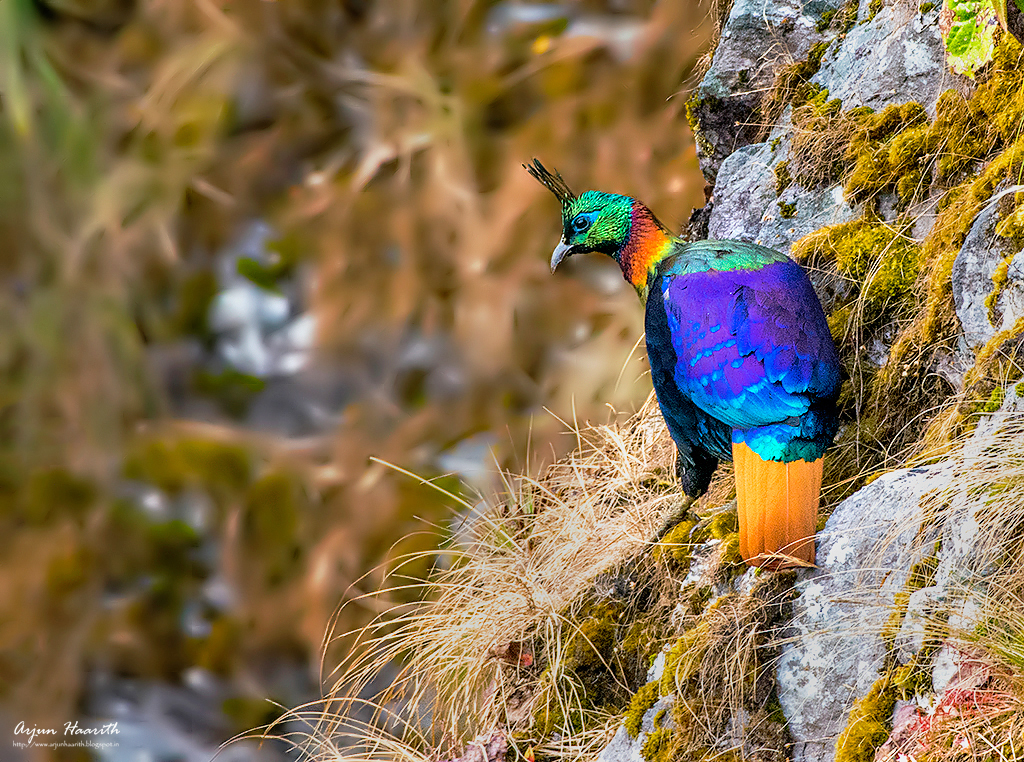
While descending, we saw a Monal pheasant that flew in front of us.
Within no time, we descended the hill and reached Chopta by 3.30 PM.
We then departed Chopta, and headed to Karnaprayag for a night halt.
Important Information
1) When it gets windy , it is very chilly and cold out there. So always take some jackets or woolens with you.
In winters it is very cold , hence warm woolens, jackets and thermals are necessary.
2) Lodges are open only till November. If you plan to camp or stay beyond November, do take local guidance.
3) For camping, permission needs to be taken from Forest department.
4) There is no electricity at Chopta, Tunganath.
5) For photographers, October till mid November is the best season, when the skies are clear and peaks shine. But the weather cannot be predicted in Himalayas, as we faced clouds and rains in October also.
6) During monsoon months it rains heavily , so be adequately geared (Raincoats, boots, woolens).
7) There are porters and mules available at Chopta. They usually charge 300/- to 400/- Rs for a mule one way.
8) Trekking distance, one way : Tungnath is 4 kms and Chandrashila peak is 5.5 kms
9) Please do not litter the area. It is a bio diversity hotspot, an ecologically sensitive area and moreover a holy land of Lord Shiva.
10) Pooja items are available near the temple premises.
Getting there ...
By Road : Chopta is well connected with many places like Gopeshwar , Chamoli , Rudraprayag , Almora , Bageshwar
By Rail : Nearest railhead is Rishikesh (165 kms)
Our Route ...
Chopta - Rudraprayag - Gauchar - Karnaprayag
Next Pitstop -> Karnaprayag