Showing posts with label Chandertal. Show all posts

Monday, October 31, 2016

Spectacular Spiti : Journey to Kaza (via Kunzum Pass and Losar)


(Page 3)

Day 4 - Aug 8th , 2016

By 8.00 AM, we bid good bye to this beautiful emerald lake and hoped to visit this lovely place once again.


While the charming Chandertal was still lingering in our heads, we set off to explore the interior Spiti valley. Our destination for the day was Kaza, which is an important economic district head of the Spiti valley.


The next pitstop was Kunzum pass, which was just 6-7 kms from Chandertal.


Kunzum Pass is a high mountain pass on the eastern Kunzum Range of the Himalayas some 120 km  from Manali. 


It connects the Kullu Valley and Lahaul Valley with the Spiti Valley of Himachal Pradesh, India. It is on the route to Kaza, the subdivisional headquarters of Spiti. 


The 'Congress Kadle Kai' from Iyengar bakery in Bangalore was a good companion for us in the trip. The cold weather and the tangy peanuts made a deadly combination. 


There is also a religious belief at Kunzum stupa, which goes like this. "If you place a coin on top of the main deity, and if the coin sticks to it, then your wish would be fulfilled"


The Buddhist prayer flags are tied everywhere. According to Buddhism, these prayer flags connect you to the almighty.


All your prayers will reach the god through wind is their belief.


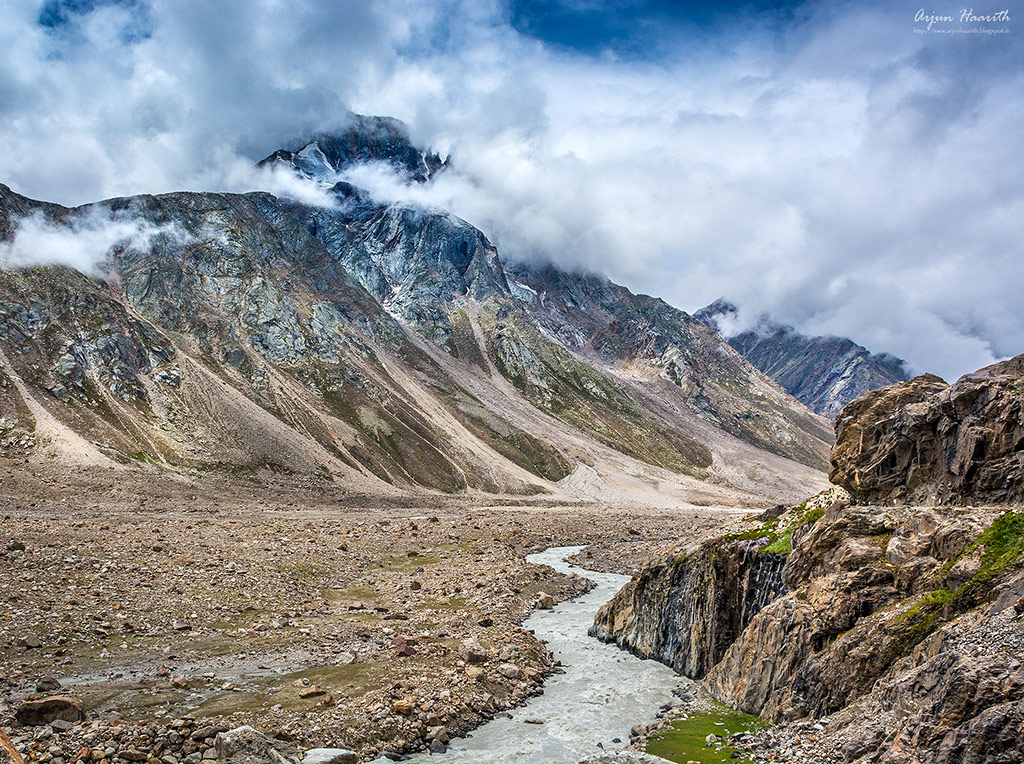
The journey from Kunzum to Kaza is breathtaking. The arid yet vibrant mountains on both sides, high passes , cold winds , valleys and rivers make you feel blessed.


The roads on this route were better compared to the ones we travelled yesterday.


The spellbinding mountains filled with aroma of fresh air has to be only experienced and cannot be explained.


The Spiti river is seen flowing through the garden of Edens. Nature has its own version of Holi is what we felt after passing through such an amazing terrain.


By afternoon, we reached another small town called Losar which is enroute to Kaza. Losar has many small dhabas and homestays which serves you with basic needs.


Losar is a small village in the Lahaul and Spiti District of Himachal Pradesh in northern India. Spiti Valley is located very close to the Indo-Chinese border and is believed to be the last mountain range before one reaches China through India. Spiti Valley is an extension of Ladakh and is a cold desert region. Losar is situated at an altitude of 13,400 feet above sea level.


The road leading to Losar has breathtaking beauty with magnificent views and different coloured mountains with waterfalls emerging through them. On any given day the weather is generally very windy and pleasant owing to its high altitude.


Losar is relatively unexplored, due to its remoteness and inaccessibility. Very few travellers spend the night at Losar, most stop for a meal and proceed to Chandra Tal Lake or the district headquarters of Lahaul and Spiti, Kaza nearby for a night halt.


Losar has very few accommodation and food options. The village houses have over the time been converted to home stays and guest houses to meet the needs of the travellers. The accommodation options are generally very basic with just a bed and bathroom. The food options are also generally very basic consisting of Chowmein, momo, dal, rice, chapati and vegetables.


The village is nestled in the centre bordered with mountains on all sides. The houses are generally made of mud and have prayer flags surrounding it. The prayer flags symbolise the Buddhist religion which is the main belief in the village.


To reach Losar one can either go via the Kunzum Pass which is a high altitude pass. Kunzum is considered to be one of the most treacherous passes in the world. One can also access the village via Kinnaur. The Kunzum pass is generally shut for most part of the year and can be accessed only during the summer months of mid-July to mid-September. Kinnaur is fairly open for most part of the year other than during winters when the temperature is sub zero.


The best time to visit Losar is from July to September when the road conditions are fairly better than most other months. To reach Losar one can either hire a private vehicle from Manali via Kunzum pass or via Kinnaur. One can also hire a private vehicle from Kaza which is 56 km. Although while traveling to Losar one must always do a prior check on the roads condition and also make sure to acclimatize properly to avoid falling sick. Considering there are no major medical facilities available at Losar the nearest hospital is situated at Kaza


The main occupation of the villagers is farming and animal husbandry but with the increase in the number of travellers each year tourism is on the rise.
The locals are also very welcoming towards the tourists. Losar is considered to be coldest place in Spiti valley and a night stay is sufficient to explore the village.


Within the village there is also a monastery which is decorated with paintings on its walls and prayer wheels around it. 


Himachal Pradesh government runs bus services from Manali to Kaza. The bus runs only once daily and halts at Losar while plying to Kaza. Bus booking has to be done much earlier, else the seats are not guaranteed (as there is only one bus per day)


We finally reached the main town of Kaza by 2.00 PM. Kaza is the district head quarters of Lahaul and Spiti valley district.


Kaza was more beautiful than I thought. It had green pastures , schools , monasteries , bridges and valleys. A small town with vibrant culture and hospitable people.


We checked in to the hotel called "Spiti Valley" which was run by Mr. Tanzin. It was a decent accommodation with pretty good food and WiFi facilities.


The evening was spent on the banks of the Spiti river by watching the sun go down. The sunset was one of the best that I had seen in my life.


We then roamed around the Kaza bazaar to check on souvenirs specific to the region and retired for the day.


Useful information / Tips to the travelers :


1. There are many hotels which provide you with accommodation at Kaza


2. Number of eateries are also on the higher side. You get to eat Indian , Chinese and other continental dishes.


3. Schools , hospitals, government offices , markets , Gompas , monastery and Petrol/Diesel stations are available here.


4. The best time to visit Kaza is from June to September. However, you can visit any time of the year.


5. Only one government bus runs per day from Manali to Kaza.

6. Mobile signals are very weak, and only BSNL works


7. Electricity is very scarce , so charge your batteries when available.


8. Manali to Kaza route will be closed in Winters. However, Kaza can be reached by the Kinnaur route from Shimla even in winters.


Thanks for viewing
To know more about the life and culture of Spiti valley, click on the link below!!


 Chandertal
(Page 2)
Kaza and beyond
(Page 4)


Spectacular Spiti : Journey to the Moon shaped lake - Chandertal


(Page 2)

Day 3 - Aug 7th , 2016

We checked off from the hotel by 6.00 AM , and hit the main road in no time. The mighty Beas was flowing to our left until Rohtang pass. A small Chai break at a nearby village called Kothi was a energy booster for us. As and when the altitude gained , the sleeves started to come down and as we neared Rohtang, we dressed in layers.

The road until Rohtang pass is a curvy ghat section road that takes you through thick virgin forests with beautiful landscapes. The clouds and sun started to play hide and seek with us, which made our visibility less for most of the time.


By 8.00 AM, we were near Rohtang pass. This place is a famous pit stop for people going towards Ladakh or Spiti region.


Rohtang Pass, is a high mountain pass on the eastern Pir Panjal Range of the Himalayas, around 51 km from Manali. It connects the Kullu Valley with the Lahaul and Spiti Valleys of Himachal Pradesh, India.


When you are driving through these high altitude roads, do not miss to see the slogans and information by BRO. It is very humorous and informative.


This place is truly a gateway to the Himalayan odyssey. You can see large number of tourists until this point, and only travelers go beyond. 

(note the difference between tourists and travelers)


Heavy lorries and trucks ply on this route frequently. The skills of these drivers are truly exceptional, and I was really amazed by that.


The weather started to clear post Rohtang pass, which was a sigh of relief for us.


Each and every turn made us closer to the destination and our minds were eagerly waiting to see the snow peaks.


The roads were really bad, as it was completely filled with small rocks and streams that we had to brave upon.


A beautiful waterfalls that was seen enroute. They are the main feeders to the Chenab river, that can be seen down in the valley while moving towards Chandertal.


We then crossed a small village called Chatru which houses just a couple of tents. This place is a very good pit stop for refreshment breaks.


A cup of hot Maggi noodles was all that was needed to complement the weather. Maggi is your best friend in the mountains.


Enroute Chnadertal, we need to cross many mountain ranges and small villages. The views are extremely colorful and breath taking.


For every few metres, you tend to stop the vehicle and click photos.


We met many riders who rode all the way from Delhi , Chandigarh and some from Manali as well.


Just an idea on how the road conditions are, while travelling in the Spiti valley.

I met a group of riders who were from Bangalore. It seems they had shipped their bikes from Bangalore and started their journey from Chandigarh.I was really happy to see  "Karnataka" registration vehicles high up in the mountain valleys.


A curious onlooker who stood wondering on what I was doing with my camera.


Venki shooting the arid landscape at Batal.

Batal is also a very small village which houses a small tent owned by an elderly couple. The tea and food they prepared were really delicious. 


Landscape started to change every now and then. So did the colors , vibrance and the lighting of the place.


A panorama comprising of almost 7-8 images. 


The colors of the valley are truly amazing . What you are seeing in the above image is one single mountain which had different color shades.


The monsoon clouds were fast approaching and that added drama in the sky. The Chandra river is seen all along the way while driving towards Chandertal.


We reached the base of Chandertal by 2.00 PM. The tents were seen from quite a distance, and we were really excited to see our new homes.


The tents at Chandertal were priced differently, based on the number of person occupancy and the luxury provided in there. An average two bed tent was rented for around Rs. 3200, which also had a private bathroom.


This price included dinner and breakfast(for the next day) as well.


After searching and negotiating among many tent owners, we finally settled on one from Mr. Tanzin. This was a single 6 bed tent which was being offered for Rs.3600 for the whole tent along with food. 


The lunch was not a part of the package, so it was served for an extra payment.

Our lunch was Maggi, while some others from our group savored the lunch which was prepared by some shepherds.

By around 4 PM we set off to see the majestic crescent shaped emerald lake. It was a small walk of around 3-4 kms from the basecamp.


Chandra Tal (meaning the Lake of the Moon), or Chander Tal is situated in the Spiti part of the Lahul and Spiti district of Himachal Pradesh (India).The name of the lake originates from its crescent shape. It is situated at an altitude of about 4,300 metres (14,100 ft) in the Himalayas. The mountains overlook the lake on one side, and a magnificent valley presents a view on the other. 


The team

Chandra Taal is a popular destination for trekkers and campers. The lake is accessible on foot from Batal as well as from Kunzum Pass from late May to early October. There is also a motorable road from Batal which is 14 km (8.7 mi) away from Chandra Taal.


Bhargav enjoying the view

Vast meadows on the banks of the lake are the camping sites. During springtime, these meadows are carpeted with hundreds of kinds of wildflowers.


The lake is situated on the Samudra Tapu plateau, which overlooks the Chandra River.


The lake is one among the two high-altitude wetlands of India which have been designated as Ramsar sites.


If there were no clouds, we could have seen the snow capped peaks from here. It is indeed a magnificent view from this place. 


Except Bhargav and Satish uncle, we all went to the top of another hill to view the golden sunset.


It is believed, Chandratal was discovered by traders who came to the region from Tibet or Ladakh. After an arduous journey, the traders used to rest near the lake before resuming their journey to Kullu or Spiti.


The sweet water lake is around 2.5 km wide. It is the source of Chandra River which merges with Bhaga River to form Chandrabhaga River and later assumes the identity of Chenab.
The lake can be visited only during the three summer months. For the rest of the season, the lake remains cut off and frozen.


Though the place is barren and bereft of any human settlement, it is a famous camping site during summer. 


Travelers often get awestruck by the blue colour of the lake, bordered by wide carpet of green grass coupled with the pristine white of Chandra Bhaga mountain range.


After the sunset we set off towards our tents by walking in the darkness. Satish uncle did not join us as he had already gone back to the tent much earlier. 


Bhargav at the valley
However, Bhargav was waiting for us at a small view point. And after sometime, we even lost track of him as he had gone to the tent all by himself.


We reached the tent around 7.00 PM, and were served with a hot cup of soup. It helped us regain our lost energy and brought the dead cells back to life. 

The dinner was served by 9.00 PM. Post that, we hit the bed to earn a well deserved sleep, as it was a long and tiring day. The whole night was a circus, as none of us could sleep properly. The cold winds & less space made us go crazy.


Useful information :


1. Options to stay are limited in Chandratal. PWD guesthouses and rooms let out on rent by villagers at Kunzum Pass and Batal are the main options to stay. In summer, majority of the tourists prefer to stay in camp at Chandratal.


2. Options to eat are limited in Chandratal. There are some small dhabas at Batal which offer food. The eateries(tents) in Chandratal offer limited Indian food. 


3. Don’t expect any exotic cuisine.


4. The best time to visit Chandratal is from June end to September end.


5. Camping is allowed near Chandertal, and many people offer their tents on a rental basis.


6. The price for each tent differs.


7. Lunch is not included in the package. Only dinner and breakfast are counted


8. Vehicles do not go till the lake, we need to walk for around 2kms from the last parking point of the vehicles


9. Do not litter the place. Plastic should be banned


10. Be a responsible traveler / tourist.


11. The mercury drops during night. Stay warm by dressing in layers


12. Symptoms such as flu , fever, head ache are common at high altitudes. Do not be panicked 


Thanks for viewing

How is the journey from Chandertal to Kaza ?? To know more, click on the link below


Subscribe via email

Please subscribe to get regular updates from my blog ...

Enter your email address:

Delivered by FeedBurner