
Trip to Agumbe was planned few weeks back and accordingly the train tickets were also booked. The train was at 11.15pm (Shimoga express), but my uncle called me up by 8.00 pm and said that , " the rains were blasting the malnaad region continuously for past few weeks and had not stopped. So its better we plan it later " . Even I analyzed the situation and said that , " let us cancel the trip " (Though i did not want to ). Both of us were in 50-50 situation. Finally we made up our mind and said, " we'll continue the trip and let us see what happens when we go there ".
I guess this decision made us visit heaven. Heaven is also not a proper word to describe the beauty of Malnaad region during monsoons.
We visited Agumbe this year to watch the rains " Mungaaru male " in Malnaad region. This plan was from many years and this year it got worked out. So we boarded a train to Shimoga at 11.15pm in Bangalore on July 18th 2011. We reached Shimoga at 5.20 AM the next day. The rains had already started at Shimoga as it was drizzling in the railway station. But after 1/2 hour, the rains seemed to stop. We went to the bus stand to board a bus to Hebri (Sitanadi nisargadhama). In the mean time, to beat the cool weather we sipped some hot refreshing coffee in a nearby hotel. Wow, this was really hot, and it took me very long to finish . By then the bus was ready to leave.
The board there read
"ದೇಗುಲಗಳ ಬೆರಗು , ಜೋಗದ ಸೊಬಗು , ಆಗುಂಬೆಯ ಬೆಡಗು .... ಪ್ರಸಿದ್ಧ ಪ್ರವಾಸಿ ತಾಣಗಳ ತವರು ಶಿವಮೊಗ್ಗ ಜಿಲ್ಲೆಗೆ ನಿಮಗೆ ಸುಸ್ವಾಗತ."
I was almost in heaven when I saw this board.
The bus left Shimoga at 6.15AM . The weather was good until we reached Sakrebylu. Once we crossed the place, the clouds opened up. Man, the rains did not stop for a long time. And it was like , the bus was going under a waterfall. The sound of rain was amazing. The bus stopped at Theertha-halli for breakfast. We had some Idli-Vada's and the local dish " Buns". I guess many people in city would not have tasted the buns. The Buns are one of the best snack which is found there. You people have to go there and try one, I am sure you will enjoy it to the core.
This time, the rains had stopped for a while, and again it started..Rains at Malnaad is different from what we get here. Sometimes, it rains heavily and at times it is slow. But it rains, and rains steadily. Just when I thought it stopped ,and opened my camera bag it rained heavily.The route to Hebri from Shimoga was via Gajanur dam , Sakrebylu , Mandagadde bird sanctuary , Theerthahalli , Agumbe and Hebri. These are all some of the must-visit places enroute.
The bus reached Hebri by 9.15AM. The route from Agumbe to Hebri is breath taking. It contains some deep curves and turns, and the drivers have to be very careful while driving in these araes. We could see the glimpse of the river Sita, while going to Hebri. It was flowing with all its might. We brought gifts to our best friends. The friends were the Leeches and the gift was Salt. Again from Hebri we had to come back 5kms to go to the Sitanadi Nature camp.

Someshwara Wildlife Sanctuary is located in the Western Ghats in Udupi district. Someshwara was declared a wildlife sanctuary on 5th June 1974. The area of Someshwara Wildlife Sanctuary is about 88.4 sq. km.
Someshwara Wildlife Sanctuary has semi-evergreen and evergreen forests. The sanctuary includes of two unconnected parts, the smaller part being situated to the Southwest of the major part. The Kudremukh National Park lies to the Southeast of this sanctuary.
Machilus Macrantha, Lophopetalum wightanium and Artocarpus hirsuta are some of the species of flora found in this sanctuary.
Mammals in the Someshwara Wildlife sanctuary include Tiger, Leopard, Wild Pig, Sambar, Spotted Deer, Wild Dog, Jackal, Gaur, Barking Deer, Lion Tailed Macaque, Bonnet Macaque and Common Langur.
Reptiles are represented by King Cobra, Python and Monitor lizard.
Someshwara Wildlife sanctuary also houses some interesting birds like Malabar trogon, Ceylon frogmouth, Malabar pied hornbill and Malabar whistling thrush.
Nearby tourist attractions include the Onakeabbi Falls, Kudlu theertha falls , Agumbe Sunset Point and Jamblu Tirtha.
Sitanadi Nisargadhama :
This was the place where we stayed. It has a beautiful nature camp which contains lodges and dormitories, with some nature trails. There is also some guided treks.
The Nature camp is situated on the banks of Sita river.
" When we arrived at the Nature camp, it made me feel as if we entered a wonder land. The places is so beautiful, that you have to go there one day. The cottages are inside the forests, and you have to trek for a while from the main gate. After we reached our room, we could see the river was hardly 50 mtrs from us. The previous day, the news channels were showing about the floods in Sita river. When we went there , I could feel the floods. The benches were almost sunk in the river."
 The one in the front is the dormitory , the back buildings are bathrooms and toilets.
I guess this decision made us visit heaven. Heaven is also not a proper word to describe the beauty of Malnaad region during monsoons.
We visited Agumbe this year to watch the rains " Mungaaru male " in Malnaad region. This plan was from many years and this year it got worked out. So we boarded a train to Shimoga at 11.15pm in Bangalore on July 18th 2011. We reached Shimoga at 5.20 AM the next day. The rains had already started at Shimoga as it was drizzling in the railway station. But after 1/2 hour, the rains seemed to stop. We went to the bus stand to board a bus to Hebri (Sitanadi nisargadhama). In the mean time, to beat the cool weather we sipped some hot refreshing coffee in a nearby hotel. Wow, this was really hot, and it took me very long to finish . By then the bus was ready to leave.
The board there read
"ದೇಗುಲಗಳ ಬೆರಗು , ಜೋಗದ ಸೊಬಗು , ಆಗುಂಬೆಯ ಬೆಡಗು .... ಪ್ರಸಿದ್ಧ ಪ್ರವಾಸಿ ತಾಣಗಳ ತವರು ಶಿವಮೊಗ್ಗ ಜಿಲ್ಲೆಗೆ ನಿಮಗೆ ಸುಸ್ವಾಗತ."
I was almost in heaven when I saw this board.
The bus left Shimoga at 6.15AM . The weather was good until we reached Sakrebylu. Once we crossed the place, the clouds opened up. Man, the rains did not stop for a long time. And it was like , the bus was going under a waterfall. The sound of rain was amazing. The bus stopped at Theertha-halli for breakfast. We had some Idli-Vada's and the local dish " Buns". I guess many people in city would not have tasted the buns. The Buns are one of the best snack which is found there. You people have to go there and try one, I am sure you will enjoy it to the core.
This time, the rains had stopped for a while, and again it started..Rains at Malnaad is different from what we get here. Sometimes, it rains heavily and at times it is slow. But it rains, and rains steadily. Just when I thought it stopped ,and opened my camera bag it rained heavily.The route to Hebri from Shimoga was via Gajanur dam , Sakrebylu , Mandagadde bird sanctuary , Theerthahalli , Agumbe and Hebri. These are all some of the must-visit places enroute.
The bus reached Hebri by 9.15AM. The route from Agumbe to Hebri is breath taking. It contains some deep curves and turns, and the drivers have to be very careful while driving in these araes. We could see the glimpse of the river Sita, while going to Hebri. It was flowing with all its might. We brought gifts to our best friends. The friends were the Leeches and the gift was Salt. Again from Hebri we had to come back 5kms to go to the Sitanadi Nature camp.
Someshwara Wildlife Sanctuary is located in the Western Ghats in Udupi district. Someshwara was declared a wildlife sanctuary on 5th June 1974. The area of Someshwara Wildlife Sanctuary is about 88.4 sq. km.
Someshwara Wildlife Sanctuary has semi-evergreen and evergreen forests. The sanctuary includes of two unconnected parts, the smaller part being situated to the Southwest of the major part. The Kudremukh National Park lies to the Southeast of this sanctuary.
Machilus Macrantha, Lophopetalum wightanium and Artocarpus hirsuta are some of the species of flora found in this sanctuary.
Mammals in the Someshwara Wildlife sanctuary include Tiger, Leopard, Wild Pig, Sambar, Spotted Deer, Wild Dog, Jackal, Gaur, Barking Deer, Lion Tailed Macaque, Bonnet Macaque and Common Langur.
Reptiles are represented by King Cobra, Python and Monitor lizard.
Someshwara Wildlife sanctuary also houses some interesting birds like Malabar trogon, Ceylon frogmouth, Malabar pied hornbill and Malabar whistling thrush.
Nearby tourist attractions include the Onakeabbi Falls, Kudlu theertha falls , Agumbe Sunset Point and Jamblu Tirtha.
Sitanadi Nisargadhama :
This was the place where we stayed. It has a beautiful nature camp which contains lodges and dormitories, with some nature trails. There is also some guided treks.
The Nature camp is situated on the banks of Sita river.
" When we arrived at the Nature camp, it made me feel as if we entered a wonder land. The places is so beautiful, that you have to go there one day. The cottages are inside the forests, and you have to trek for a while from the main gate. After we reached our room, we could see the river was hardly 50 mtrs from us. The previous day, the news channels were showing about the floods in Sita river. When we went there , I could feel the floods. The benches were almost sunk in the river."


This was how the Sita river had been flooded. The coarse which you can see in the distance is the actual river. But due to rains it had expanded . You can see the bench in the left side(middle), which has been submerged in water.
This was the condition of western ghats in monsoons.
 |
Cottage at Sitanadi nature camp |


The forests of western ghats are the home of the most feared snake -
" The King Cobra "
The king cobra (Ophiophagus hannah) is the world's longest venomous snake, with a length up to 5.6 m (18.5 ft). This species is widespread throughout Southeast Asia and parts ofIndia, and is found mostly in forested areas. The king cobra can be highly aggressive and agile, and can deliver a large quantity of highly potent venom in a single bite. It is regarded as one of the most dangerous and feared Asiatic snakes due to various factors
 |
| Red helen |
We went for an evening walk in the nature trail. It started to rain, so we came back to the room, and ate some hot "Onion pakodas".... wow, this was just amazing. Imagine..." Its raining outside, and we are sitting on the bench and eating hot pakodas "... I know you are jealous on me :)
After the rain stopped, we again roamed around the nature camp. Now it was late and the sun had set. It was almost 9pm. We went in search of frogs that inhabit the region.
It was pitch dark and we could only hear the flooded Sita river, Sound of Cicadas and the croaks of frogs.
We took some torches and roamed around the Nature camp by moving through bushes and trails to find the croaking creatures . We were also very cautious about snakes too :)
 |
| Moss that grows on trees in evergreen forests |
Click here to know - More about frogs
 |
| I have no idea about the identity of this frog. Some say it is Bull frog and some say it is wrinkled frog. I will update about the id, once I come to know |
 |
| Bicolored Frog |
 |
| Amboli bush frog |
 |
| Front pose - Amboli bush frog |
 |
I guess it is Wrinkled frog Skink |
 |
| Forest Lizard You can feel the monsoon effect in this picture. |
 |
| Lizards are a widespread group of squamate reptiles, with nearly 3800 species, ranging across all continents except Antarctica as well as most oceanic island chains. The group, traditionally recognized as the suborder Lacertilia, is defined as all extant members of the Lepidosauria (reptiles with overlapping scales), which are neither sphenodonts (i.e., tuatara) nor snakes – they form an evolutionary grade. While the snakes are recognized as falling phylogenetically within the anguimorph lizards from which they evolved, the Sphenodonts are the sister group to the Squamates, the larger monophyletic group, which includes both the lizards and the snakes. |

These were the animals that we photographed last night. The next morning we got up early, and again started to trek in and around the Nature camp along the trails. We had a delicious breakfast (Avalakki oggarane along with coconut chutney). This was the best chutney I had ever eaten.
It was sunny, so we went in search of smaller animals around us. But after a while, it again started to rain and did not stop for a long time . There was a shelter nearby and we ran towards it. Here we could see 2 peacocks and a beautiful Malabar Giant Squirrel.
Later we went back to the room, and were tired for a while. After that the search of leeches had begun. The itch was all over, and we could figure out many leeches around our legs and hands. Wow, getting bitten by a leech is a magical experience.
 |
| Leech which had bitten After the removal of leeches, we had some hot tea under a tree, and it was raining all over.  I was busy shooting a Cicada, my uncle called us, saying that there was a Pit Viper nearby. I left the cicada and ran towards the viper. It was in a striking pose when it failed to catch a lizard that passed by it. "When I went near the viper, I was literally shocked, because it was the place where we were shooting frogs last night , by keeping torches and moving around the bushes" |

 |
| Hump nosed pit viper Bites from this species though previously thought to be innocuous, is now known to cause serious complications such as coagulopathy and acute renal failure . |
After shooting the pit viper, we trekked in a different route across the trail. This was around the tents. I imagined that if I could photograph a king cobra nearby, but suddenly we saw some movements around a small bush. with curiosity, we moved towards it. There was a green vine snake, which was very aggressive.


 |
| Green Vine snake The green vine snake stays high on trees and looks down to the ground. When a mouse, lizard or nest is found the snake follows the prey a short distance and smells it carefully. If the snake is content with it, it bites into the head and lifts the prey 20–40 cm from the ground. With this the snakes prevents the prey from using its physical strength. The vine snake has two larger teeth at the back of its mouth; these teeth permit the toxic saliva to penetrate the wounds and to immobilize the prey. Then it is rapidly swallowed. Once the prey is completely in the snakes body, the vine snake searches for a resting place, usually in the highest point of a tree.   After the photography session, it was time for us to go back to Agumbe. So we moved towards our room, on the way back it rained heavily. |


We packed off from heaven, and went to another heaven called Agumbe.
I knew that Agumbe was called as " Cheerapunji of south" , but when I went to Agumbe, I realized the caption.
In Agumbe we stayed at Kasturakka's House. She treated us very well . She is a very hospitable person. The food which she prepares is amazing. In fact there are no adjectives to express the taste.
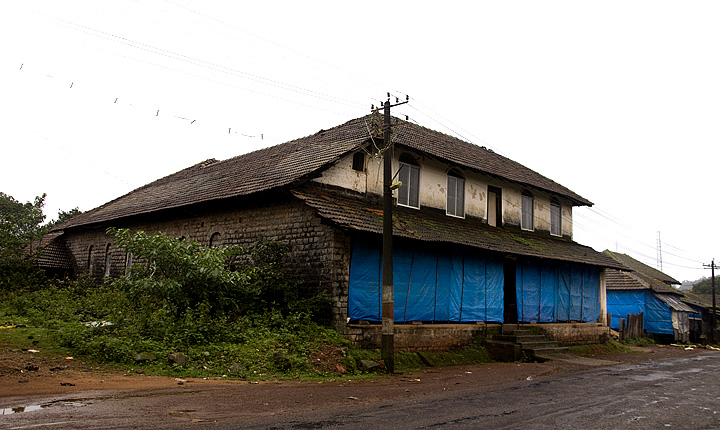 |
| Kasturakka's house at Agumbe This is the house where the famous " Malgudi Days " was shooted. She initially gave us hot delicious Kashaaya. We went to the room upstairs kept our luggages and went to the Sunset point. |
 |
| Mist covered landscape at Sunset point This was the place where Dr.Rajkumar's song " Agumbeya prema sanjeya..." from film " Aakasmika" had been shooted. |

 |
Tourists walking towards Sunset point in Rain Sunset point : Image courtesy : H.Satish After shooting pictures at the sunset point, we went back to Kasturakka's house. This stretch was about 3km , and we walked in complete mist in the rain forest for 3km. This was a magical experience. We went back to Kasturakka's house, drank hot Kashaaya, and went back to our room, to change the wet clothes and dry our cameras. It was almost dark when we reached her house. Ate food (typical malnaad food). For more details about the food click on the link which I give at the end of the blog. Then we moved to the neighboring house to photograph frogs. |

In the morning, we went to ARRS.
Agumbe Rainforest Research Station (ARRS) is an ecological research station situated in the rainforests of Agumbe, Karnataka, India. It is situated on the crest of the Western Ghats at about 640 metres (2,100 ft) above sea level. This area has been identified as one of the world’s Biodiversity Hotspots, and is part of the Agumbe Rainforest Complex, which includes the Someshwara Wildlife Sanctuary, the Kudremukh National Park, the Mookambika Wildlife Sanctuary, and the Sharavathi Valley Wildlife Sanctuary, and various other smaller tracts around Kundapur, Shankaranarayana, Hosanagara, Sringeri, and Thirthahalli
 |
| Kundadri hills |
Later, we went to Kundadri Kundadri [kannada: ಕುಂದಾದ್ರಿ ] is a mountain peak with dense forests in the Western Ghats in South India (Karnataka State). This well-preserved land of Karnataka is home to 17th century Jain temple that is not much given to architecture. Two small silent ponds formed by the rock on one side of this temple leave you wondering at its presence on this height. Throughout the year you can find lotus flowers in the pool which is also a breeding ground for some fishes- both large and small.
After leaving Kundadri, we left to Jogi Gundi falls which is on the Sringeri route.
This is a beautiful falls, which is formed by the river Malapahaari.
 |
| Jogi Gundi falls |
 |
| Frog photographed enroute to Jogi gundi |
 |
| Interior of Kasturakka's house. |
 |
| With Kasturakka |

She was cutting Kalale "Bamboo", which is a famous food of Malnaad region.
ಮನಸಿಲ್ಲದ ಮನಸಿನ್ನಿಂದ ಮತ್ತೆ ಬೆಂಗಳೂರಿಗೆ ನಾವು ಹೊರೆಟೆವು.
 |
| Town of Agumbe |
 |
| The team : Satish, Arjun, Venkatesh I hope all of you have enjoyed the blog. You can also follow this blog which is written by Mr.Venkatesh about our trip . ಮತ್ತೆ ಮಲೆ(ಮಳೆಯ)ನಾಡಿಗೆ..... |
Route Map
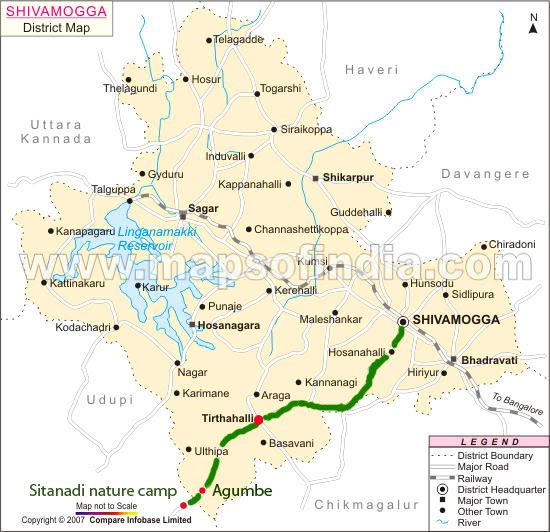
Image courtesy : Maps of India



